How Do Pension Round-Ups Work - And Will They Affect My Day-to-Day Spending?

You buy a coffee for £3.60. You automatically save 40p into your pension.
That’s it. That’s a pension round-up.
It sounds almost too small to matter. But that’s exactly the point - and it’s also why round-ups work when bigger, more ambitious saving plans don’t. They’re invisible. They don’t require willpower.
And there’s one thing a pension round-up does that a savings round-up can’t: because the money you save goes into a pension, it picks up tax relief - a 25% top-up from the government for basic-rate taxpayers, on every contribution. A savings account simply can’t do that.
So let’s break down how they work, what happens to your money, and whether you’ll notice any difference to your everyday spending.
TL;DR
A round-up takes the spare change from each purchase and redirects it — in Chest’s case, straight into your pension pot.
The amounts are tiny (usually pennies per transaction), so your day-to-day spending feels much the same.
The key advantage over a savings round-up: pension contributions attract tax relief, so even small round-ups get a 25% top-up from the government for basic-rate taxpayers.
Over months and years, those pennies — boosted by tax relief and long-term investment growth — can add up to something genuinely meaningful.
Capital is at risk when investing. Tax treatment is subject to personal circumstances and may change in the future. Pensions are long term investments.
Why a Pension Round-Up Beats a Savings Round-Up
Rounding up your purchases into a savings pot has been a feature in banking apps for years. So what makes a pension round-up different? One word: tax relief.
When you put money into a pension, the government adds to it. For basic-rate taxpayers, every 80p you contribute is topped up to £1.00 - a 25% uplift, applied automatically. (Higher and additional-rate taxpayers can claim further relief through self-assessment.) You can read the detail in our simple guide to pension tax relief.
So that 80p round-up from your lunch? With basic-rate tax relief, it becomes £1.00 in your pension pot - before it’s even had a chance to grow. A savings account can’t do that. That’s the whole case for pointing your spare change at your pension rather than a rainy-day pot, and it’s the bit most people miss.
What Is a Pension Round-Up, Exactly?
A round-up is an automated saving rule that takes the difference between what you actually spent and the next whole pound - and puts your spare change somewhere useful.
Spend £4.20 on lunch? Your round-up is 80p. Spend £12.75 on a book? Your round-up is 25p. Spend exactly £10.00? No round-up at all.
The idea has been around in savings apps for a while. But pension round-ups are different, because the money you save goes directly into your pension rather than sitting in a low-interest savings account - where, as we’ve just covered, it can earn a 25% top-up due to tax relief.
How Do Pension Round-Ups Actually Work?
Here’s the step-by-step of what happens when a round-up is triggered.
Step 1: You make a purchase
You pay for something with your card - a coffee, a train ticket, your weekly shop. Whatever it is.
Step 2: The round-up is calculated
Your pension app connects to your bank account via Open Banking, which lets it read your transaction data securely. It spots the purchase, calculates the difference between what you paid and the next pound, and logs it as a round-up.
Step 3: The spare change is collected and sent to your pension
Rather than moving 20p here and 60p there in real time (which would mean dozens of tiny bank transfers), round-ups are typically batched and transferred periodically - daily or weekly, depending on the app. That batch then goes into your pension pot as a contribution.
Step 4: Tax relief is applied
Because it’s a pension contribution, HMRC adds tax relief on top. For basic-rate taxpayers, that’s a 25% government top-up. Higher-rate taxpayers can claim additional relief through their self-assessment tax return.
Step 5: The money is invested
Once in your pension, the contribution is invested in line with your chosen fund - and starts working for your future.
The whole process is automatic. You don’t need to think about it, move money manually, or remember to save. You just spend normally, and the pennies find their way to your pension.
Will Round-Ups Actually Affect My Day-to-Day Spending?
This is the question most people really want answered. The honest answer: probably not in any way you’d notice.
Here’s a realistic look at the numbers.
What a typical week of round-ups looks like
Say you make 20 card transactions in a week - a coffee, a few lunches, a supermarket run, a couple of online orders. On average, each round-up is around 50p (it could be anywhere from 1p to 99p, but 50p is a reasonable midpoint).
That’s roughly £10 a week in round-ups, or about £40 a month.
Transactions per week | Average round-up | Weekly total | Monthly total |
|---|---|---|---|
10 | 50p | £5 | ~£20 |
20 | 50p | £10 | ~£40 |
30 | 50p | £15 | ~£60 |
These aren’t huge amounts. But they’re also not nothing - especially once tax relief is factored in.
The “will I feel it?” test
The key thing about round-ups is that they work with how you already spend, not against it. You’re not being asked to cut back on anything. You’re not setting a savings target and hoping you stick to it. You’re just rounding up what you were already going to spend anyway.
The psychological difference is significant. Manually transferring £40 to your pension feels like a sacrifice. Watching 40p here and 60p there disappear into a round-up? You barely register it.
That’s not a bug - it’s the whole point. Behavioural finance research consistently shows that automatic, low-friction saving outperforms manual saving, because it removes the moment of decision (and the temptation to skip it).
What if I’m really tight on money?
If your budget is genuinely stretched, the good news is that most round-up features can be paused or adjusted. You’re in control. Round-ups aren’t a direct debit you’re locked into - they’re a tool you use when it suits you.
On months where every penny counts, pausing round-ups for a bit is a perfectly reasonable call. The point is to build a habit over time, not to squeeze yourself when things are tight.
Do Small Round-Ups Actually Add Up to Anything?
Yes - more than most people expect. The maths isn’t complicated, but the compounding effect is easy to underestimate.
Say you contribute £40 a month through round-ups. With basic-rate tax relief, that becomes £50 a month in your pension pot - £600 a year before any investment growth. Money held in a pension is then invested, with the aim of growing over the long term, though as with any investment the value can go down as well as up.
The earlier you start, the longer those contributions are invested. A pound contributed at 25 has roughly 40 years until a typical retirement age; a pound contributed at 45 has around 20. Over long periods, compounding means the timing of a contribution can make a meaningful difference to what it’s ultimately worth.
Research from MoneyHelper shows that even small, consistent contributions made early can make a meaningful difference to retirement outcomes. Round-ups alone won’t get you to a comfortable retirement - but they’re a genuinely useful piece of the puzzle, especially for anyone who struggles to find “spare money” to save.
The honest take: Round-ups are not a retirement strategy on their own. They’re a low-effort starting point - or a supplement to bigger contributions. Think of them as the automatic version of the “keep your change” habit, but pointed at your future instead of a jar on the kitchen counter.

Pension Round-Ups vs. Savings Round-Ups: What’s the Difference?
Worth addressing directly, because the two sound similar but work quite differently.
Savings round-ups | Pension round-ups | |
|---|---|---|
Where the money goes | A savings pot or account | Your pension pot |
Tax relief | No | Yes (25% top-up for basic-rate taxpayers) |
Investment growth | Depends on account type | Invested with the aim of long-term growth |
Access | Anytime | From age 55 (rising to 57 in 2028) |
Best for | Short-term goals, emergency fund | Long-term retirement saving |
The trade-off is access. Money in a pension is locked away until you’re 55 (the minimum pension access age is rising from 55 to 57 in April 2028). That’s the right constraint for retirement money - but it does mean round-ups into a pension aren’t a substitute for a rainy-day fund.
The smart approach: use savings round-ups to build a short-term buffer, and pension round-ups to build long-term wealth. They’re not competing - they’re complementary.
If you want to understand more about how pensions work and why they’re worth starting early, that’s a good place to start.
How Chest Uses Round-Ups
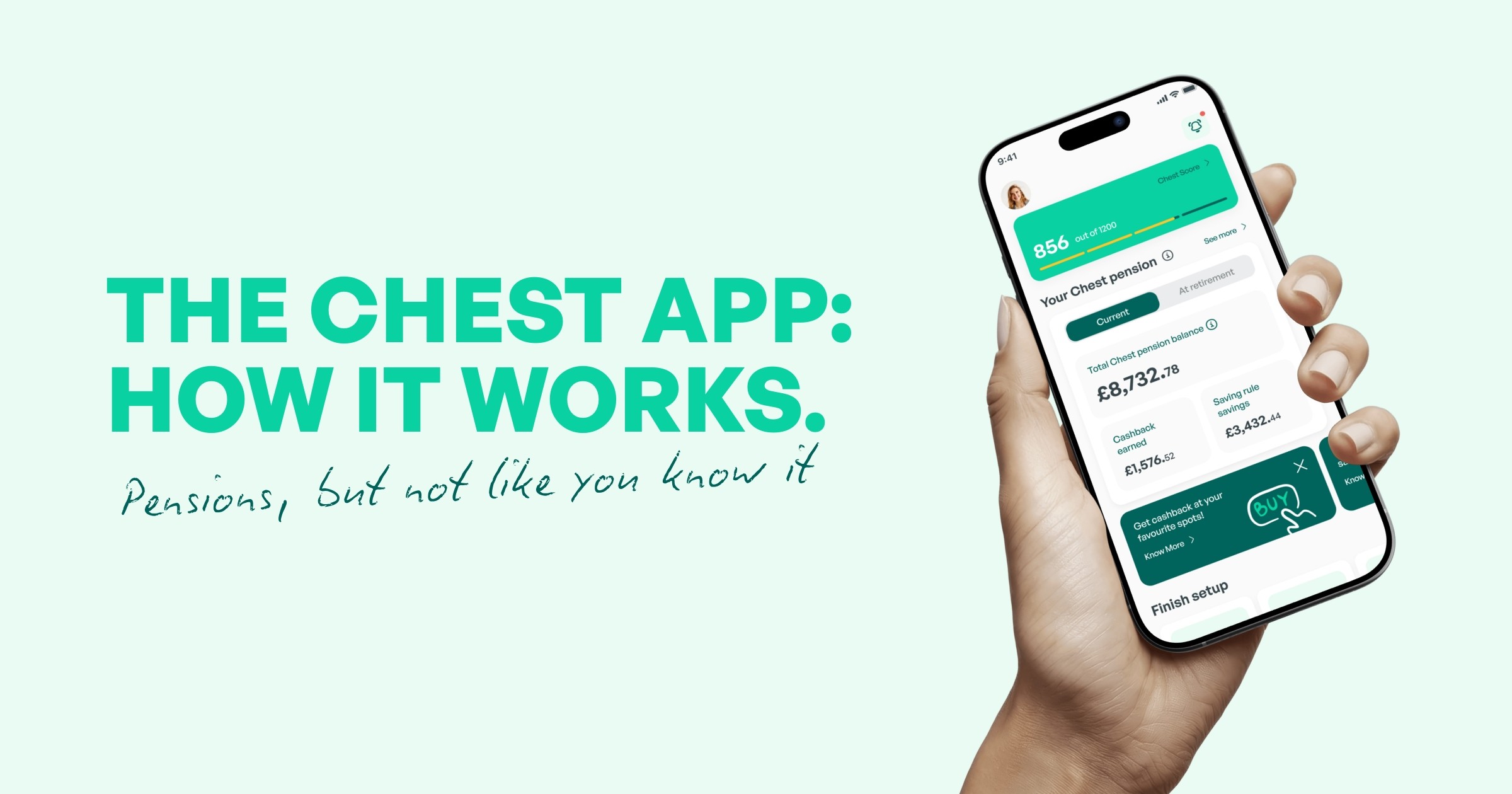
At Chest, round-ups are one of several automated saving tools built into the app - and they’re designed to work alongside cashback from everyday brands, not instead of it.
Here’s how it fits together:
Round-ups collect the spare change from your card purchases and direct it to your pension pot.
Discretionary cashback from 120+ partner brands is paid into your pension on your behalf.
Monthly deposits let you set a regular contribution on top.
Open Banking rules can trigger contributions based on your spending patterns.
The idea is that your pension grows through what you already do - spending, shopping, living your life - rather than requiring you to find extra money from somewhere.
Because Chest is a SIPP (Self-Invested Personal Pension), contributions - including round-ups and manual deposits - qualify for pension tax relief, so that 25% basic-rate top-up applies to them automatically. Cashback contributions are paid in on your behalf, and are also subject to the 25% basic-rate top-up.
Higher and additional-rate taxpayers can usually claim further relief on top - through a self-assessment tax return. And certain limits apply: tax relief is available on contributions up to 100% of your UK earnings for the tax year (or £3,600 gross if you earn less than that), and everything you put in counts towards your annual allowance.
Capital is at risk when investing. Tax treatment is subject to personal circumstances and may change in the future. This content is for general information only and isn’t financial advice - it doesn’t take into account your individual circumstances. If you’re unsure what’s right for you, consider speaking to a qualified financial adviser.
The Bottom Line
Pension round-ups are one of the most painless ways to build retirement savings —-precisely because they don’t feel like saving.
The amounts per transaction are small enough that your spending feels completely normal. But they’re consistent, automatic, and - crucially - they go into a pension, where tax relief and long-term investment growth aim to turn those pennies into something meaningful.
The short version:
Round-ups take the spare change from your card purchases - usually pennies at a time.
They won’t affect your day-to-day spending in any noticeable way.
Directed into a pension, they attract tax relief that boosts every basic-rate contribution by 25%.
Over years and decades, the compounding effect makes even small contributions matter.
They work best as part of a broader approach to pension saving - not as a standalone strategy.
If you’ve been putting off your pension because it feels complicated or expensive, round-ups are a decent place to start. Not because they’ll solve everything, but because starting is the hardest part — and round-ups make starting almost effortless.
Want to see how Chest brings round-ups, cashback, and pension saving together? Find out how Chest works - or join the waitlist to be first in when we launch.
Pensions are an investment product. Capital is at risk. Tax treatment is subject to personal circumstances and may change in the future. This content is for general information only and isn’t financial advice - it doesn’t take into account your individual circumstances.